
Most social content doesn't fail because of bad ideas. It fails because posting on the fly is exhausting. You sit down to share something, realize you have nothing queued, and either scramble out something forgettable or skip it entirely. Over and over.
Batching fixes that. One focused afternoon, a month of posts ready to go.
Why batching beats posting on the fly
When you post reactively, every single day demands a creative decision under pressure. You're staring at a blank screen, context-switching from actual work, and hoping something good comes out. It rarely does.
Batching separates two completely different mental modes: creation and distribution. During a batching session your only job is to make things. Later, your only job is to hit publish. Keeping those apart means you produce better work in less total time.
There's also a compounding benefit. When you write ten captions in a row, you find a rhythm. Ideas connect to each other. One post suggests the next. You end up with a coherent thread of content rather than ten random thoughts. That coherence is what audiences feel as a "consistent voice," and it's nearly impossible to fake when you're posting one at a time, days apart.
Before you start: gather your ingredients
A batching session stalls when you spend the first twenty minutes hunting for things. Set yourself up before the clock starts.
Brand assets on hand:
- Your logo and brand color reference (even a screenshot works)
- A folder of 8-12 recent photos (products, workspace, team, events)
- One or two past posts that performed well, for tone reference
An ideas list: Keep a running note on your phone for the two weeks before your session. Drop in anything: a question a customer asked, a comment that made you think, a process step you're proud of, a result you got. Aim for 20-30 raw seeds. You won't use all of them, but you'll never stare at a blank screen.
A simple calendar grid: A spreadsheet, a paper grid, or a free scheduling tool. Map out the days you want to post and what platform each is for. This becomes your fill-in-the-blanks template.
A time block: Three to four hours, uninterrupted. Put your phone on do-not-disturb. This is focused maker time.
The focused batching session, step by step
- Open your ideas list and pick your best 20. Quickly scan everything and mark the ones with the clearest angle. Don't overthink it, just flag the ones that feel alive.
- Map ideas to calendar slots. Drop each flagged idea into a day on your grid. Aim for variety: no two teach posts back to back, mix in some personal and some promotional. Slot gaps are fine, you'll fill them in step 4.
- Write all your captions in one pass. Open a doc and write every caption without stopping to edit. First drafts only. Momentum matters more than polish at this stage.
- Edit and tighten the batch. Now slow down. Read each caption aloud. Cut the preamble. Sharpen the hook (the first line). Add a clear call to action where it's missing.
- Match photos to posts. Go through your photo folder and assign one image to each post. Note it in your grid. Flag any slots that need a graphic instead.
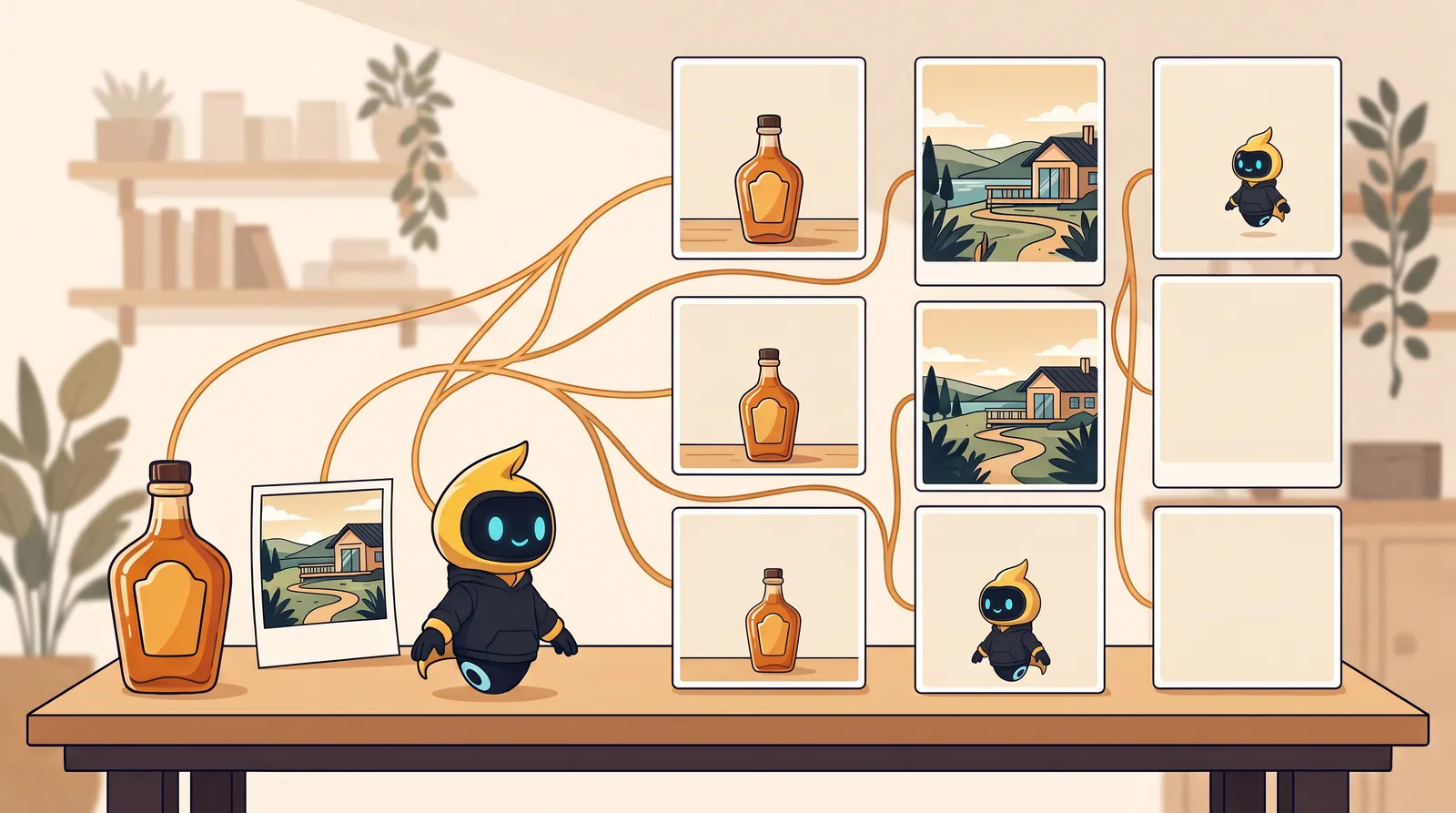
- Create any graphics you need. If you're using an AI tool for visuals, do all your image generation in one go now. Batch the visual work the same way you batched the writing.
- Load everything into your scheduler. Drop captions, images, and dates into your scheduling tool. Review each one before confirming. You're done.

Five content shapes to fill your calendar
Having a content shape in mind makes writing faster because you know exactly what job the post is doing before you start. These five cover nearly every business situation:
- Teach. Share one specific thing you know that your audience doesn't. A common mistake in your industry. A faster way to do something. A framework you use. The more concrete the better.
- Behind-the-scenes. Show the work. A photo from your process, a candid moment from a project, a look at how you do something most people don't see. These build trust without selling.
- Proof/testimonial. A result a client got. A before-and-after. A kind message someone sent you (with their permission). Social proof stated plainly, not as a brag but as evidence.
- Ask/engage. A genuine question for your audience. What's your biggest challenge with X? Which would you choose, A or B? Questions invite conversation and tell you what your audience actually cares about.
- Offer. A clear invitation to work with you, sign up, book a call, or take advantage of something. One post per week or two is plenty. Make the offer specific and limit the friction.
Rotate through these shapes and you'll never have a calendar that feels like all promotion or all noise.
Repurpose: turn one idea into a week of posts
One strong idea doesn't have to become one post. A single topic can be stretched across an entire week if you change the format and the angle each time.
Say your idea is: "We reduced our client onboarding time from two weeks to three days."
- Monday (teach): The three bottlenecks we identified and how we fixed them.
- Tuesday (behind-the-scenes): A photo of the new onboarding checklist on our whiteboard.
- Wednesday (proof): A quote from a client about how smooth it felt.
- Thursday (ask): "What part of onboarding do you find most frustrating as a new client?"
- Friday (offer): "If you're dealing with slow onboarding, let's talk. Link in bio."
Same core idea, five completely different posts, all of them authentic. This approach also reinforces your message through repetition without feeling repetitive, because each angle serves a different purpose for a different reader on a different day.
The goal isn't to manufacture content. It's to get your real expertise, your real work, and your real results in front of people consistently enough that they remember you when the moment comes to buy.
If you want more frameworks, examples, and tools like this, the Beevi blog is where we keep them.