
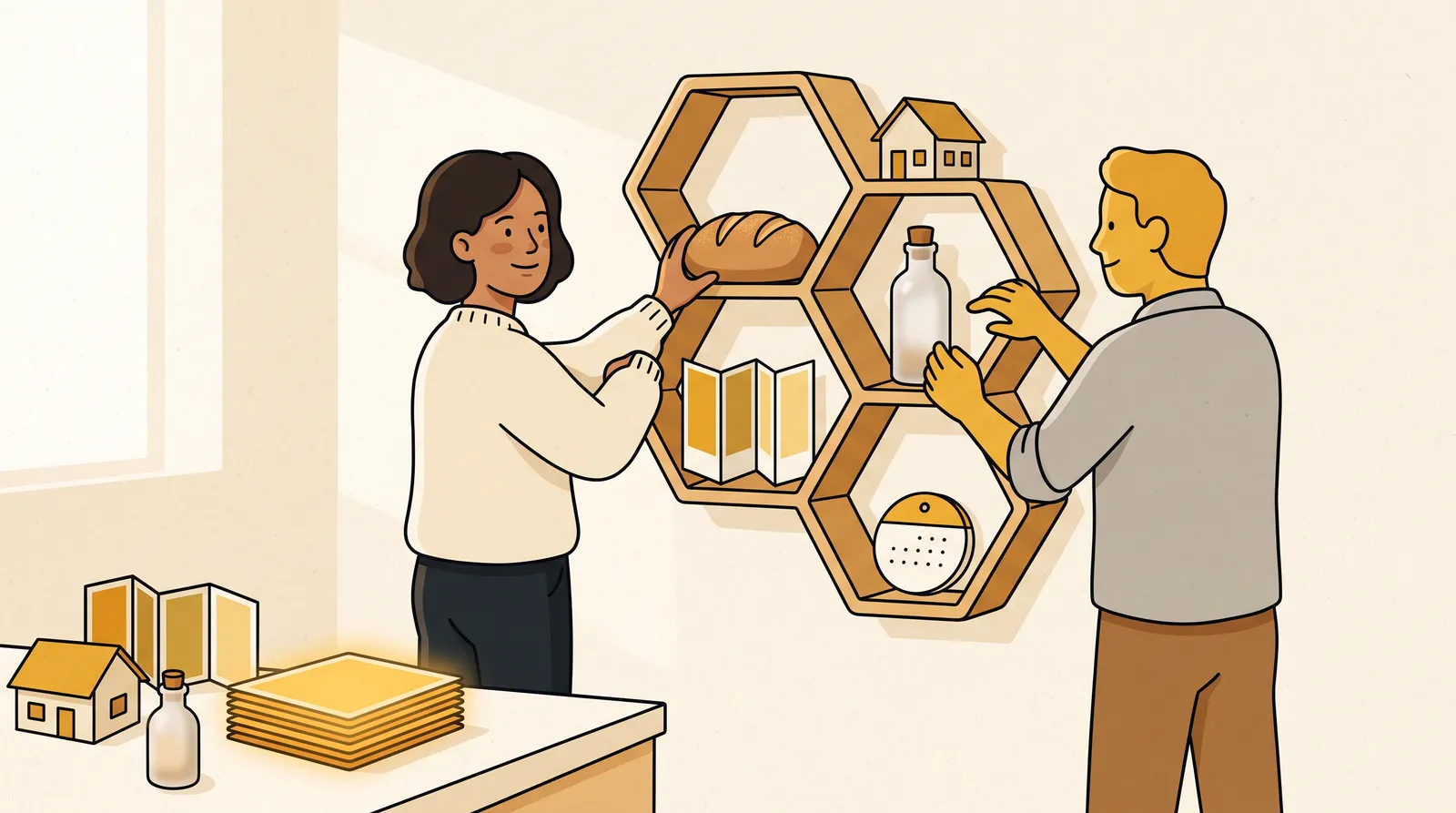
Give reusable brand facts a permanent home
Beevi Brand Memories give your business a reusable source of truth for the details that shape accurate, specific social content. Instead of retyping product ingredients, service boundaries, pricing notes, founder quotes, policies, or recurring campaign angles for each post, you can store those details in Beevi's Brain and reference the right memory when it matters.
Useful context is often scattered across old captions, team messages, documents, and one person's head. A rushed prompt omits a detail. A teammate remembers an old price. A generic caption uses language the business would never choose. Review then becomes a fact-finding exercise instead of a final quality check.
Brand Memories make that context reusable. Beevi can learn your brand identity, plan content, write, design, schedule, and keep publishing work moving behind approval. The Brain holds business knowledge that does not fit neatly inside your core identity.
What belongs in Beevi's Brain
Your brand identity should explain who you are: your voice, audience, positioning, visual direction, and broad guidelines. Brand Memories hold facts and instructions that become important in particular posts. Think of them as labeled notes your social media manager can pull into the brief.
Useful memories might include:
- Product details, sizes, ingredients, materials, or service inclusions
- Pricing context and the conditions that affect it
- Recurring promotion angles, seasonal themes, or campaign talking points
- Approved founder quotes and origin-story details
- Policies such as delivery areas, booking rules, returns, or allergen language
- Phrases your business avoids for a particular offer
- Menu facts, listing details, consultation boundaries, or product care instructions
A memory can be referenced through an @-mention in the form @[Name](memory:uuid). When you reference it, Beevi inlines the memory as text for that prompt. Storing a memory gives you a reusable fact, but you should not assume every memory is automatically applied to every generation. Reference it when you want that information included in the content brief.
Decide where each piece of context belongs
Before saving something, ask whether it defines the brand broadly, needs to be reused for a specific topic, or matters only for today's post.
| Put it in | Best for | Example | Why |
|---|---|---|---|
| Brand Identity | Stable, business-wide direction | "Warm, informed, never pushy" or "We serve first-time homebuyers in South Florida" | It should guide most content across topics |
| Brand Memories | Specific facts or instructions you will reuse | "The sourdough rests for 36 hours" or "The strategy session is 75 minutes" | It matters often, but not in every post |
| One-time prompt | Temporary details for one piece of content | "Promote Saturday's tasting between 11 a.m. and 2 p.m." | It will expire or has no value after this post |
If a detail should shape almost everything, place it in Brand Identity. If you will need it again but only in relevant content, save it as a Brand Memory. If it expires after one post, keep it in the prompt.
This prevents two mistakes: bloating your brand identity with every specification and temporary offer, or asking your team to reconstruct important facts whenever they brief a post.

Build a memory library around real content work
You do not need to document the entire business before creating content. Start with details that your team repeatedly searches for, corrects during approval, or explains in prompts. Each correction is a clue that a memory may be missing.
A bakery could create memories called Sourdough process, Weekend pickup policy, and Allergen wording. The process memory might state the fermentation time and flour blend. The pickup memory could record the order cutoff and collection window. A behind-the-scenes post references the process memory. A preorder post references the pickup policy too.
A realtor might save Listing description rules, Open house checklist, and Neighborhood positioning. A property post can reference verified listing facts while the prompt supplies the date and creative angle. This helps avoid captions that add an unverified feature or reuse details from another property.
A consultant could store Signature workshop, Approved founder bio, and Claims to avoid. The workshop memory can hold the session length, audience, format, and deliverables. A thought-leadership post might reference the founder bio, while a workshop sales post pulls in the service facts and boundaries.
A product brand might keep Hero product specifications, Care instructions, and Holiday gifting angles. One memory holds durable specifications. Another records exact care guidance. A seasonal campaign can reuse the gifting angles without confusing them with product facts.
Use short, descriptive names. Spring offer final final will age badly. Ceramic mug care instructions tells a creator when to use it. Keep each memory focused enough to add useful context without flooding the prompt.
Reference memories when the post needs them
A good content prompt still needs an objective. Brand Memories supply trusted context; they do not replace the reason for the post, the audience, or the desired action.
Suppose the bakery wants an Instagram post about why its sourdough sells out on Saturdays. The prompt can set the angle and tone, then reference @[Sourdough process](memory:uuid) for the facts. A separate post about preorder deadlines would reference the pickup policy. There is no reason to pull every bakery memory into both prompts.
The same discipline helps a team. Instead of writing, "I think the consultation is an hour, but check with Maya," the team references the approved service memory. Instead of copying a founder quote from an old slide deck, it references the stored quote. Everyone can see which source should govern the content.
Before generating, use this compact workflow:
- State what the post should achieve and who it is for.
- Reference the one or two memories that contain the needed facts.
- Add temporary context, such as a date, location, stock update, or channel.
- Generate, review the output, and send it through your normal approval process.
More context is not always better. Pulling six unrelated memories into a simple announcement can make the brief noisy and the caption less focused.
Reduce factual drift without freezing your content
Factual drift happens when a detail changes as it moves from one caption to the next. A 60-minute consultation becomes "about an hour," then 90 minutes. A product described as recycled is later called fully recyclable. A delivery promise loses the geographic limitation that made it accurate. These mistakes come from rebuilding context through memory and copy-paste.
A reusable source of truth narrows that room for drift. When the same approved memory is referenced across relevant briefs, creators start from the same details. Content can still vary by channel, campaign, and audience. The facts do not need to vary with it.
It also improves specificity. Generic prompts produce captions that could belong to any bakery, realtor, consultant, or product brand. A focused memory supplies the material that makes a post recognizably yours: the 36-hour rest, the neighborhoods you serve, the format of your workshop, or care instructions for your best-selling item.
When a price, policy, or product detail changes, update the source before referencing it in new work. Old published posts may still contain the previous information, so review any live content customers could treat as current.

Keep approval as the final gate
Brand Memories improve the starting context. They do not remove the need for human review. A stored fact can be outdated, referenced in the wrong situation, or phrased poorly for a platform. A generated caption can also be accurate while missing the intended emphasis.
Approval remains the final gate before publishing. The reviewer should confirm that facts are current, the offer is valid, the wording fits the channel, and the post reflects what the business can deliver. This is especially important for prices, deadlines, regulated claims, property details, health-related language, and policies with exceptions.
Reviewers can focus on judgment rather than reconstruction. They spend less time asking where a number came from or rewriting a generic explanation of the service. They can concentrate on the question that needs a person: is this the right thing for the brand to say right now?
Beevi supports an approval-first workflow, so autonomous planning and creation can keep moving while the business controls what goes live. Brand Memories give drafts better source material before they reach the reviewer.
Start with the facts you corrected last week
The easiest first memory is probably hiding in recent feedback. Find the product detail someone fixed, the policy someone pasted from a document, the phrase a founder asked to remove, or the campaign angle you expect to reuse. Save that as a clearly named memory.
Then create one post that needs it and reference the memory explicitly. Review the draft as usual. If the context was too broad, split it. If it missed an important condition, update it. A useful Brain grows from real work, not from a documentation marathon.
Over time, this creates a practical content knowledge base: stable direction in Brand Identity, reusable facts in Brand Memories, and timely instructions in each prompt. Beevi can use that structure to plan, write, design, schedule, and keep publishing work moving, with approval still protecting the final result.
Explore more practical guides on the Beevi blog or review Beevi pricing.