Does your post sound like AI?
Paste a post, get a score, and see every AI tell highlighted with a plain fix.
- Free
- No signup
- Stays in your browser
How the score works
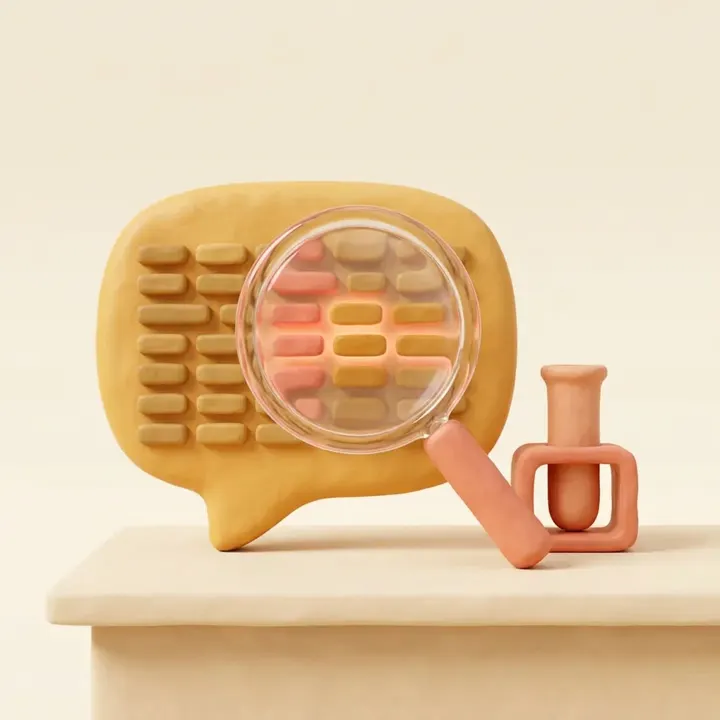
The checker looks for habits that chatbots are known for: certain words ("delve", "seamless"), stock phrases ("in today's fast-paced world"), sentence shapes ("It's not X. It's Y."), layout (emoji bullets, every sentence on its own line) and stock endings ("Drop your favorite below 👇"). Each habit has a weight. The weights are added up per 100 words, so a long post is not punished for being long, and the total becomes a score from 0 to 100.
Human starts at 0. Polished starts at 25. Suspicious starts at 50. Pure slop starts at 75. Every highlight says why readers notice it and gives a plain swap. The score says a post sounds like AI. It never says who wrote it.
How we tested it
On the AI side, we used 682 English captions that Beevi's own AI writer produced for 105 real businesses. On the human side, 1,200 public texts written before chatbots were around, so they are certainly human: tweets, Reddit posts and Yelp reviews. Each text was cut to caption length, at most about 220 words. We set the weights on one half of each sample and tested on the other half, which the weights never saw.
We drew the Suspicious line so that fewer than 1 in 20 human texts reach it. On the held-out half, 58% of the AI captions scored Suspicious or higher, against 4% of the human texts. With Polished included, it was 83% of AI captions against 12% of human texts. Our own writer did not get a pass, which is the point of testing on it.
| Tell | AI captions | Human texts |
|---|---|---|
| Hyphen used as a dash | 72% | 10% |
| "It's not X. It's Y." | 34% | 1% |
| Three-word drumroll | 19% | 1% |
| Repeated openers | 19% | 1% |
| "No X. Just Y." | 8% | 0% |
| "The result? ..." | 5% | 2% |
The surprise: the famous AI words barely showed up. Only 5% of the AI captions used even one of them, against 2% of human texts. The tells have moved from words to sentence shapes. Beevi's writer is told not to use the long dash, so it reaches for a spaced hyphen instead, which is why the hyphen tops the table and the long dash does not. Elsewhere, the long dash is the better known habit, and a study of more than 15 million biomedical abstracts found "delves" 28 times more often in 2024 than the earlier trend predicted, so the word list stays in.
We also measured sentence rhythm, the idea that AI writes sentences of even length. On our samples it barely told the two apart, so it carries almost no weight. Numbers last checked 2026-10-09. Human text sources:
What it cannot do
It cannot prove anything about who wrote a post. A person can write every one of these habits, and a careful AI draft can avoid them all. Short texts are the hardest: 8% of the human tweets in our test reached Suspicious, mostly because one habit in 40 words weighs a lot. It reads English only, and it was tested on social captions, not essays or school work. Please do not use it to accuse anyone.
Questions people ask
What are the common signs of AI writing?
Sentence shapes more than single words. The most common ones are "It's not X. It's Y.", three short fragments in a row ("Fresh. Local. Yours."), sentences that all start on the same word, "No X. Just Y.", a question answered in the next breath, and a long dash or a hyphen used for a dramatic pause. Words like "delve", "elevate" and "seamless" are famous too, but in social captions they turn up far less than the sentence shapes.
Can this tell me if a post was written by AI?
No, and no tool can know that for sure. This checker measures how much a post sounds like AI: it counts the habits chatbots are known for and shows you each one. People use these habits too, and a careful AI draft can avoid all of them. Read the score as "how a reader might react", never as proof of who wrote it.
How accurate is the AI slop detector?
We tested it on 341 captions written by AI and 600 texts written by people before chatbots existed, none of which were used to set the weights. It scored 58% of the AI captions as Suspicious or higher, and 4% of the human texts. We set the line so that fewer than 1 in 20 human texts cross it, because calling a person a robot is the worse mistake.
Does using an em dash mean a text was written by AI?
No. Writers have used the long dash for centuries. It became a famous AI tell because chatbots use it a lot for a dramatic pause. One dash costs very little here. Several in a short caption add up, and so do spaced hyphens used the same way, since some AI writers are told to avoid the long dash.
How do I make my writing sound less like AI?
Click each highlight and use the plain swap, then read the post out loud. Cut the setup lines ("Here's the thing:", "Let that sink in."), keep only the second half of any "not X, but Y" sentence, and replace one general claim with one specific detail: a name, a number, a thing that happened this week.
How do I prove I didn't use AI?
A checker cannot prove it, including this one. What works is a record of your process: the version history in Google Docs or Word, your notes and early drafts, and being able to talk through why you wrote what you wrote.
Is the text I paste stored or sent anywhere?
No. The check runs in your browser with a fixed list of rules. Nothing is uploaded, and the share card and link carry only the score and the types of tells, never your words.
More free tools
 LinkedIn cringe meterPaste a post, get a cringe score from 0 to 100, and see exactly which lines did it.
 AI label checkerPick the platform and what AI did. Get a yes or no, the rule behind it and the switch to use.
 Social media character counterPaste once and see your draft against every platform limit, bios included.
When you want the posts written for you
Beevi learns your brand and drafts posts for six platforms. You approve every post before it goes live. Try it free for 7 days.
Start your free trial