Most lists of the best restaurant social media campaigns stop at "look what McDonald's did." That's fun to read, but you don't have a national ad agency, a Netflix deal, or a social team of twelve. You have a menu, a few regulars who love you, a phone, and maybe 20 minutes a day.
So this list does something different. For each campaign, you get what happened, why it worked, and a small-restaurant version you could run this month with your own dishes and staff. At the end there's a goal-to-campaign table and a four-week template you can copy.
🍔 The 10 best restaurant social media campaigns (and the small-restaurant version of each)
1. Chipotle's #LidFlipChallenge
What happened: A Chipotle employee's casual trick of flipping a burrito bowl lid shut got reposted and racked up views. Chipotle turned it into a TikTok challenge with creators, and the campaign reportedly passed 250 million views.
Why it worked: It started from something real that staff already did. Nobody had to invent a gimmick, and anyone could join in.
Your version: Watch your kitchen for one repeatable, satisfying move: the pizza stretch, the latte pour, the crepe flip, the way your line cook plates the signature dish. Film it the same way every week for a month, same angle, same sound. Invite guests to try it at home and repost the best attempts.
2. Chili's Triple Dipper creator stories
What happened: After the Triple Dipper went viral in 2024, Chili's kept the momentum going in 2025 by letting nine TikTok creators tell their own stories around it, like date nights, friend groups, and car meals, instead of handing them a script. The campaign reached 21.7 million people with a 9.02% engagement rate, and the Triple Dipper now accounts for 15% of the chain's sales.
Why it worked: The dish showed up inside real moments, not ads. Creators kept their own voice.
Your version: Pick your most shareable dish and ask two or three local food creators (or just loyal regulars with a decent following) to come in on you. Don't script them. Your only brief: show how you'd actually eat this with friends. Repost with their permission and thank them by name.
3. HAAM's local creator test (the one built for small restaurants)
What happened: HAAM, a New York City restaurant, worked with four local food creators instead of one big influencer. In 30 days the collaborations produced 37 verified tables, and a creator with 15 times fewer followers brought in five times more first-time guests than one with over 30,000 followers.
Why it worked: Local relevance beat follower count. People who live nearby can actually come in.
Your version: Search Instagram and TikTok for creators who post about your neighborhood, not your whole city. Offer a meal and a simple way to track results, like a unique code or "mention this post for a free dessert." Count redemptions, not likes.
4. Wendy's "Nuggs for Carter"
What happened: In 2017 a teenager asked Wendy's how many retweets he'd need for a year of free nuggets. Wendy's replied "18 million." The tweet went on to become one of the most retweeted posts in Twitter's history, and Wendy's gave him the nuggets anyway.
Why it worked: The brand played along with a customer's joke instead of ignoring it. It cost nothing to make.
Your version: Reply to comments like a person, fast and with a bit of humor. When a regular jokes "I'd come every day if you brought back the brisket sandwich," answer with a challenge: "Get this post to 200 comments and it's back for one weekend." Then actually do it, and post the result.
5. Wendy's roasts and a standing brand voice
What happened: Wendy's built an ongoing roast format where followers ask to be playfully insulted, and the brand replies with sharp, funny burns. It turned one-off attention into a voice people recognize.
Why it worked: A recurring format gives followers a reason to come back and gives the team a repeatable content engine.
Your version: You don't need to roast anyone. Pick one recurring format that fits your personality: "Chef rates your order," "Guess the special," or "Friday staff pick." Run it on the same day every week so people start to expect it.
6. Chipotle's Fajita Quesadilla hack
What happened: When TikTok creators popularized a secret-menu quesadilla, Chipotle embraced it and added it to the digital menu. The move produced two of the brand's top digital sales days and a 37% jump in loyalty enrollments.
Why it worked: Chipotle let its fans co-create the menu, then rewarded them for it.
Your version: Ask followers: "What would you order if you could mix any two of our dishes?" Pick the best answer, make it a one-week special named after the follower (with permission), and film them trying it.
7. Popeyes vs. Chick-fil-A: the chicken sandwich wars
What happened: In 2019 Popeyes launched a chicken sandwich and replied to a Chick-fil-A tweet with a short "...y'all good?" The back-and-forth took over social media and news coverage, and Popeyes reportedly sold out a ten-week supply in about eight days.
Why it worked: It gave people a side to take. A friendly rivalry is easy to share.
Your version: Keep it warm, not mean. Team up with the coffee shop or bakery next door for a "taste-off" week: their pastry vs. your dessert, followers vote in Stories, loser buys the winner's staff lunch. Both businesses share it, so you swap audiences.
8. McDonald's "Raise Your Arches"
What happened: McDonald's showed people silently raising their eyebrows to mimic the golden arches, a quiet signal to friends that it was time to eat. No burger needed on screen.
Why it worked: It turned a brand symbol into a simple gesture anyone could copy.
Your version: Find your own small ritual. Maybe it's the bell your kitchen rings for the daily special, the way staff greet regulars, or a bread basket that always comes out first. Show it in short clips and give it a name your regulars can use.
9. Chipotle's Extra Fork Collection
What happened: For National Fork Day in April 2025, Chipotle sold a limited box of 53 of its black plastic forks, with two free entree cards inside. It sold out within minutes, and one creator's unboxing video passed a million views.
Why it worked: It rewarded an inside joke fans already shared (that Chipotle's forks somehow make the food better).
Your version: What do your regulars joke about? The giant mugs, the hot sauce, the "secret" table by the window? Turn it into a tiny limited drop: 20 branded mugs, a hot sauce bottle, a reserved-table night. Announce it on social only so followers feel like insiders.
10. Dunkin' Spidey D
What happened: For Halloween 2024, Dunkin' let a chaotic spider-doughnut character "take over" its social accounts. In one week, 28 posts drew over 2.5 million engagements and 100,000 new followers, and Dunkin' set a Halloween sales record.
Why it worked: A character with a strong personality made the feed feel unpredictable and fun to follow.
Your version: A mascot or recurring character works at any size: the house cat, the sourdough starter with a name, the grumpy-but-lovable pizza oven. Give it a voice for one week around a holiday. Keep it on-brand and something your team is comfortable with.
🎯 Which campaign fits your goal?
Big campaigns teach the idea. Your job is to match the idea to what you actually need this month.
| Your goal | Campaign type to borrow | Example above | Effort | What to count |
|---|---|---|---|---|
| New faces through the door | Local creator visits | HAAM, Chili's | Medium (outreach + free meals) | Code redemptions, new bookings |
| More engagement from current followers | Recurring format or challenge | Wendy's roasts, Lid Flip | Low, once it's set up | Comments, saves, repeat viewers |
| Launch a new dish | Fan co-creation or limited drop | Fajita Quesadilla, Extra Fork | Low to medium | Orders of the new item |
| Get noticed by your whole neighborhood | Friendly rivalry or collab | Chicken sandwich wars | Medium (needs a partner) | New followers from the partner |
| Make the feed fun to follow | Character or ritual | Spidey D, Raise Your Arches | Low | Shares and follows |
Decision rule: pick one goal, one campaign type, and one number to watch. Running three campaigns at once usually means none of them gets enough posts to land.
📅 A four-week campaign template you can copy
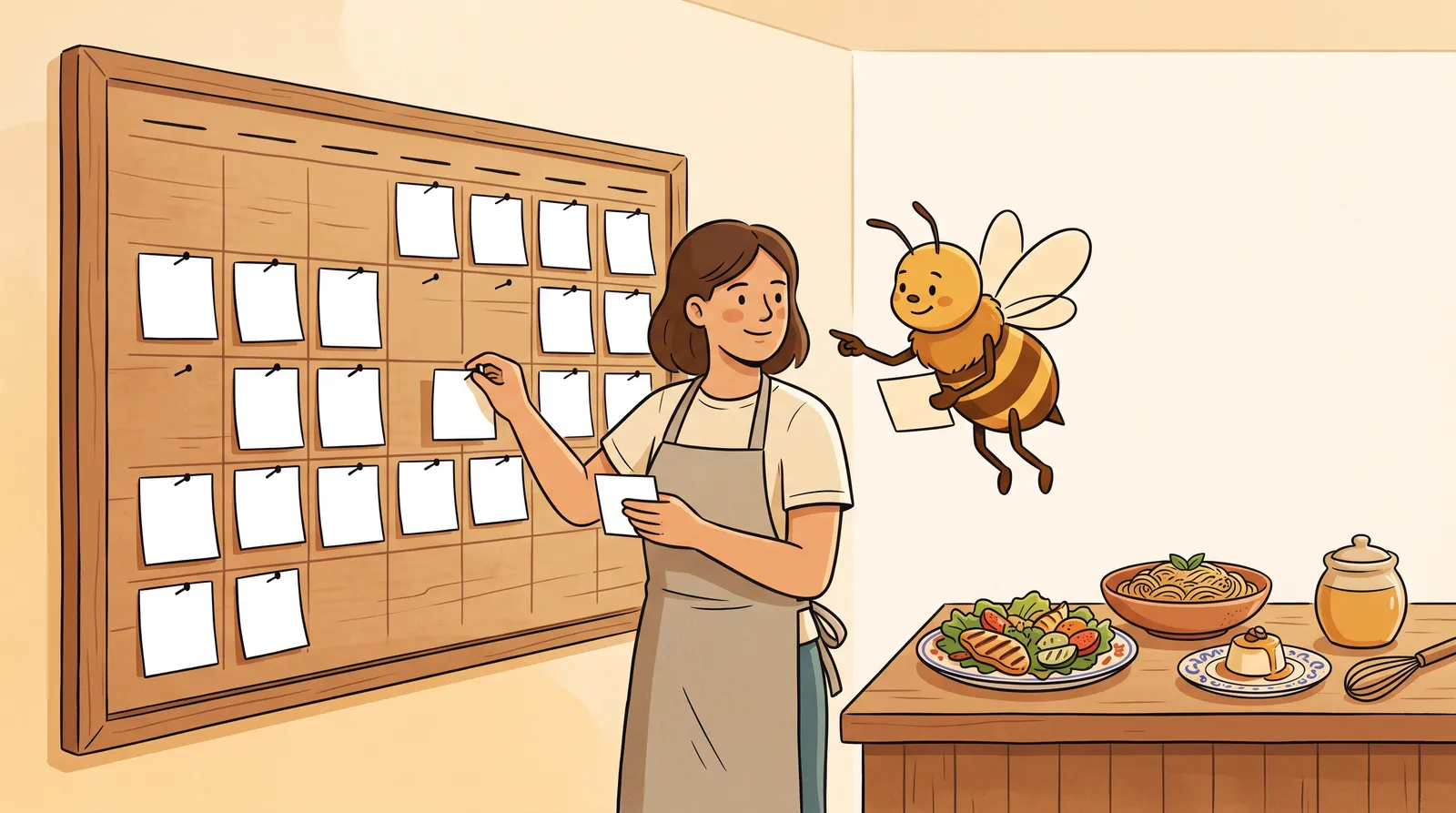
Most of the campaigns above ran as a sequence of connected posts, not a single viral post. Here's a simple four-week shape for a small restaurant. It assumes three posts a week, which most owners can keep up.
| Week | Job of the week | Post 1 | Post 2 | Post 3 |
|---|---|---|---|---|
| 1. Tease | Make people curious | Behind-the-scenes clip of the dish or idea | "Something's coming Friday" Story with a poll | Staff reacting to the first taste |
| 2. Launch | Explain and invite | Hero photo or video of the dish with a clear offer | How it's made, 15 seconds | Repost the first guest photo |
| 3. Join in | Get guests involved | Challenge, vote, or creator visit | Best guest content roundup | Reply-video to a funny comment |
| 4. Reward | Close the loop | Results ("You ordered 300 of these!") | Thank-you post naming fans or creators | What's next, plus the last chance to try it |
Adapt each post per platform rather than pasting the same caption everywhere. A vertical clip with a hook works for Reels and TikTok, a clear photo with the offer and hours works for Facebook and Google Business Profile, and a short update works for X or Threads.
⚠️ Mistakes that sink restaurant campaigns
- Copying the stunt, not the reason it worked. The Lid Flip wasn't great because of the lid. It was great because it was real and easy to join.
- Chasing big follower counts. As HAAM found, a nearby creator with a small audience can fill more tables than a big one across town.
- No offer, no way to count. "Come try it" is weak. "Show this post for a free side this week" lets you see what worked.
- Stopping after one post. Campaigns live across weeks. One post is just an announcement.
- Going off-brand for a laugh. Humor works when it sounds like you. If your restaurant is a quiet wine bar, a chaotic mascot will feel strange.
🐝 Where Beevi fits (if you want help)
The hardest part of a restaurant campaign usually isn't the idea. It's keeping up three or more connected posts a week while you run service. That's the job we built Beevi for.
Beevi is our product, so take this with that in mind. It's an AI social media manager that plans connected campaign posts around your real dishes, photos, and voice, adapts each one for 6 platforms, and waits for your approval before anything goes live. You can read more about campaign planning in Beevi.
What it won't do: Beevi doesn't book creators, run paid ads, or film your kitchen for you. The best campaign moments still come from your team and your guests. Beevi takes care of turning them into a steady, on-brand plan.
If you want a head start, try Beevi free and have it draft your first four-week campaign from this template. For single-post inspiration, our restaurant social media post ideas are a good next read, and for the bigger picture there's our guide to social media marketing for restaurants.